
The fundamental question, “How many BTUs to a ton in air conditioning?” has a straightforward answer: one ton of cooling is equivalent to 12,000 British Thermal Units (BTUs) per hour. This vital piece of information is crucial for anyone looking to purchase, install, or simply comprehend their air conditioning system. Whether you’re dealing with a small window unit or a large central AC, understanding the relationship between BTUs and tonnage is key to efficient and effective cooling. This guide will delve deep into the world of BTUs, tons of cooling, and how they relate to proper AC unit sizing and overall HVAC system sizing.
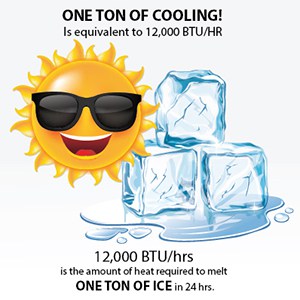
Image Source: www.acwarehouse.com
Deciphering British Thermal Units (BTUs)
At its core, a British Thermal Unit (BTU) is a unit of energy. Specifically, it’s defined as the amount of heat required to raise the temperature of one pound of water by one degree Fahrenheit. While this might sound like a simple concept, its application in air conditioning is quite profound. In HVAC, we’re not just talking about heating water; we’re talking about removing heat from the air inside your home or building.
Think of your air conditioner as a heat pump. It doesn’t create cold; it moves heat from where you don’t want it (inside your living space) to where you do want it (outside). The rate at which it can perform this heat removal is measured in BTUs per hour. A higher BTU rating means the air conditioner can remove more heat from a space in a given amount of time, thus cooling it more effectively.
The Concept of a Ton of Cooling
The term “ton of cooling” or “ton of cooling” in air conditioning doesn’t refer to the weight of the unit itself. Instead, it’s a standard measure derived from the old days of ice-based refrigeration. A ton of cooling capacity is defined as the amount of heat required to melt one ton (2,000 pounds) of ice in 24 hours.
When ice melts, it absorbs heat from its surroundings. The amount of heat needed to melt a ton of ice over 24 hours is approximately 288,000 BTUs. To find the hourly rate, we divide this by 24 hours:
288,000 BTUs / 24 hours = 12,000 BTUs per hour.
This is why the BTU to ton conversion is so consistent: 1 ton = 12,000 BTUs/hour. This standard allows for easy comparison of the cooling power of different air conditioning units.
The Crucial Role of HVAC BTU Calculation
Accurate HVAC BTU calculation is paramount for several reasons. The most significant is ensuring your air conditioner tonnage is appropriate for the space it needs to cool. Too small a unit will struggle to keep up, running constantly and failing to reach the desired temperature, leading to discomfort and increased energy bills. Too large a unit will short-cycle – meaning it will cool the space too quickly and shut off before it has a chance to adequately dehumidify the air, leaving your home feeling cool but clammy.
Factors Influencing Cooling Load
The cooling load of a space – the amount of heat that needs to be removed to maintain a comfortable temperature – is influenced by a multitude of factors. A proper HVAC BTU calculation must consider these:
- Square Footage: This is the most basic factor. Larger spaces naturally require more cooling capacity.
- Ceiling Height: Higher ceilings mean a larger volume of air to cool, increasing the cooling load.
- Climate and Location: Homes in hotter, more humid climates will have a significantly higher cooling load than those in cooler regions.
- Insulation Quality: Well-insulated homes retain cool air better and reduce heat gain, requiring less cooling. Poor insulation allows heat to penetrate easily.
- Window Type and Quantity: Single-pane windows, large windows, and windows facing direct sunlight can dramatically increase heat gain. Energy-efficient windows help reduce this.
- Shading: Trees or awnings that shade windows and walls can significantly lower the cooling load.
- Occupancy: The number of people in a space contributes to the heat load, as the human body generates heat.
- Appliances and Lighting: Heat-generating appliances like ovens, computers, and even incandescent light bulbs add to the internal heat load.
- Building Orientation: The direction your home faces and how much direct sunlight it receives throughout the day impacts heat gain.
- Air Leakage: Gaps and cracks in the building envelope allow conditioned air to escape and unconditioned air to enter, increasing the load.
Sizing Your Air Conditioner: Matching BTUs to Your Needs
This is where the BTU to ton conversion becomes a practical tool. Air conditioner capacities are typically listed in BTUs per hour (BTU/hr) or tons.
Here’s a general guideline for matching BTU capacity to room size (these are approximate and should be adjusted based on the factors above):
| Room Size (Square Feet) | Recommended BTU/hr Capacity | Approximate Tonnage |
|---|---|---|
| 100 – 150 | 5,000 | 0.5 |
| 150 – 250 | 6,000 | 0.5 |
| 250 – 300 | 7,000 | 0.6 |
| 300 – 350 | 8,000 | 0.7 |
| 350 – 400 | 9,000 | 0.75 |
| 400 – 450 | 10,000 | 0.8 |
| 450 – 550 | 12,000 | 1 |
| 550 – 700 | 14,000 | 1.2 |
| 700 – 1000 | 18,000 | 1.5 |
| 1000 – 1200 | 21,000 | 1.75 |
| 1200 – 1400 | 23,000 | 1.9 |
| 1400 – 1500 | 24,000 | 2 |
| 1500 – 2000 | 30,000 | 2.5 |
| 2000 – 2500 | 34,000 | 2.8 |
| 2500 – 3000 | 36,000 | 3 |
Factors That May Require Upsizing BTU Capacity:
- High Ceilings: If ceilings are significantly above 8 feet, you may need to increase the BTU capacity.
- Direct Sunlight: Rooms that receive a lot of direct sun, especially during peak heat hours, will need more cooling power.
- High Occupancy: Spaces frequently used by many people will require a larger unit.
- Poor Insulation/Old Home: Older homes with less efficient insulation will experience more heat gain.
- Kitchens: Kitchens often have heat-generating appliances and can require an upsizing.
- Humid Climates: In very humid areas, you might consider a slightly larger unit to improve dehumidification.
Factors That May Allow for Downsizing BTU Capacity:
- Excellent Insulation: A very well-insulated and sealed home will retain cool air better.
- Strategic Shading: Mature trees or awnings providing shade can reduce the cooling load.
- Energy-Efficient Windows: Low-E coatings and double or triple-pane windows reduce heat transfer.
- Lower Ceiling Heights: Rooms with very low ceilings may not require as much capacity.
The Pitfalls of Incorrect AC Unit Sizing
Failing to perform a proper HVAC BTU calculation can lead to several significant problems:
Undersized Unit:
- Inadequate Cooling: The unit will run constantly but may never reach the desired temperature, especially on very hot days.
- Increased Energy Consumption: The unit runs longer, consuming more electricity.
- Premature Wear and Tear: Constant operation puts excessive strain on the compressor and other components, reducing the lifespan of the unit.
- Discomfort: Your home remains uncomfortably warm.
Oversized Unit:
- Poor Dehumidification: The unit cools the air too quickly and shuts off before it can remove sufficient moisture. This leads to a cool but clammy environment, promoting mold and mildew growth.
- Frequent Short-Cycling: The on-off cycle is too rapid, which is inefficient and stresses the equipment.
- Increased Energy Bills: While it might seem counterintuitive, short-cycling can be less energy-efficient than a correctly sized unit running for longer periods.
- Uneven Temperatures: The rapid on-off cycles can lead to fluctuating temperatures throughout the home.
- Higher Upfront Cost: Larger units are generally more expensive to purchase.
How to Perform a Basic HVAC BTU Calculation
While professional HVAC system sizing by a qualified technician is always recommended, you can get a general idea of your needs using online calculators or by following these simplified steps:
- Measure Your Space: Determine the square footage of the area you need to cool. Length x Width = Square Footage.
- Find Base BTUs: Use a chart like the one provided earlier to find the base BTU requirement for your room size.
- Adjust for Factors:
- Add 10% for each of the following:
- Room is heavily shaded.
- Room is very sunny.
- Room is on an upper floor.
- Room is a kitchen.
- Add 10-20% for very high ceilings (over 8 feet).
- Add 5-10% for each person who regularly occupies the space beyond the first two.
- Subtract 10% if the area is very well-insulated.
- Subtract 10% if the area is heavily shaded.
- Add 10% for each of the following:
Example Calculation:
Let’s say you have a living room that is 20 feet long by 25 feet wide (500 sq ft). It’s on the ground floor, gets moderate sun, and typically has 3 people in it. The ceiling is 9 feet high.
- Base BTU for 500 sq ft: From the table, this is roughly 12,000 BTUs.
- Add for Sunny Room: 12,000 * 0.10 = 1,200 BTUs.
- Add for High Ceiling (9ft): Assuming 10% for ceilings over 8ft, 12,000 * 0.10 = 1,200 BTUs.
- Add for Extra Occupant (3 people – 1 extra): Assuming 10% for the third person, 12,000 * 0.10 = 1,200 BTUs.
Total Estimated BTUs: 12,000 + 1,200 + 1,200 + 1,200 = 15,600 BTUs.
Based on this, you’d look for an air conditioner around 15,000-16,000 BTUs, which would be approximately 1.3 to 1.4 tons of cooling.
Professional Load Calculations (Manual J)
For a truly accurate assessment, especially for whole-house central air conditioning, professionals use a method called Manual J. This is a standardized procedure developed by ACCA (Air Conditioning Contractors of America) that takes into account all the detailed factors mentioned earlier with much greater precision. It considers:
- Detailed building construction materials.
- Window U-values and Solar Heat Gain Coefficients (SHGC).
- Ductwork location and insulation.
- Air infiltration rates.
- Local weather data.
A Manual J calculation is essential for HVAC system sizing for central air systems to ensure optimal performance, efficiency, and comfort.
Understanding Different Types of Air Conditioners and Their BTU Ratings
Air conditioning systems come in various forms, each with its own typical BTU range:
Window Air Conditioners
These are designed for single rooms and are mounted in a window or through a wall opening.
- BTU Range: 5,000 BTU/hr (approx. 0.5 ton) to 25,000 BTU/hr (approx. 2 tons).
- Best For: Cooling individual rooms or small apartments.
Portable Air Conditioners
Similar to window units but sit on the floor and vent hot air through a hose out a window.
- BTU Range: 8,000 BTU/hr (approx. 0.7 ton) to 14,000 BTU/hr (approx. 1.2 tons).
- Best For: Temporary cooling needs or situations where window units are not feasible. They are generally less efficient than window or split systems.
Through-the-Wall Air Conditioners
These are similar to window units but are installed through a hole cut in an exterior wall, offering a more permanent installation.
- BTU Range: 6,000 BTU/hr (approx. 0.5 ton) to 12,000 BTU/hr (approx. 1 ton).
- Best For: Rooms where window installation is difficult or undesirable.
Ductless Mini-Split Systems
These systems consist of an outdoor compressor unit and one or more indoor air-handling units connected by refrigerant lines.
- BTU Range: Can range from 7,000 BTU/hr (approx. 0.6 ton) for single zones up to 36,000 BTU/hr (approx. 3 tons) or more for multi-zone systems capable of cooling multiple rooms or an entire house.
- Best For: Homes without existing ductwork, additions, or for zoned cooling.
Central Air Conditioning Systems
These systems use a network of ducts to distribute cooled air throughout an entire house or building.
- BTU Range: Typically start at 18,000 BTU/hr (approx. 1.5 tons) for smaller homes and can go up to 60,000 BTU/hr (approx. 5 tons) or more for very large homes or commercial buildings.
- Best For: Whole-house cooling and are sized based on a comprehensive cooling load calculation.
The Importance of Proper HVAC System Sizing
The cooling capacity of your air conditioner is crucial, but so is the overall efficiency and performance of your entire HVAC system sizing. This includes not just the AC unit itself but also the ductwork, thermostat, and ventilation.
Ductwork Considerations
Even the most perfectly sized air conditioner will perform poorly if the ductwork is inadequate. Undersized ducts can restrict airflow, making the system work harder and reducing its efficiency. Leaky ducts can lose a significant amount of cool air before it even reaches the rooms, negating the benefits of a correctly sized AC unit. Proper duct design and sealing are critical components of HVAC system sizing.
Thermostat Placement and Settings
The placement of your thermostat is important. If it’s located in direct sunlight or near a heat source, it will inaccurately sense the room temperature, leading to the AC running unnecessarily or not running enough. Programmable or smart thermostats can also help optimize cooling and reduce energy consumption by adjusting temperatures based on your schedule.
Energy Efficiency Ratings and BTU
When looking at air conditioners, you’ll also see energy efficiency ratings like the Energy Efficiency Ratio (EER) and Seasonal Energy Efficiency Ratio (SEER). These ratings tell you how efficiently the unit converts electricity into cooling.
- EER: Measures efficiency at a single, specific outdoor temperature (95°F).
- SEER: Measures efficiency over an entire cooling season, taking into account varying outdoor temperatures. Higher SEER ratings mean greater energy efficiency.
While cooling capacity (BTUs) tells you how much cooling a unit provides, the SEER rating tells you how efficiently it provides that cooling. A unit with a higher BTU rating is not necessarily less efficient; it just has more cooling power. It’s the SEER rating that dictates how much electricity it will use to deliver those BTUs.
Frequently Asked Questions (FAQs)
Q: How many BTUs do I need for a 1000 sq ft house?
A: For a 1000 sq ft house, the general recommendation is around 18,000 to 21,000 BTUs, which translates to 1.5 to 1.75 tons of cooling. However, this is a rough estimate. You must consider insulation, climate, window type, and other factors for an accurate HVAC BTU calculation.
Q: Can I use a 2-ton AC for a 1500 sq ft house?
A: A 2-ton AC unit has a cooling capacity of 24,000 BTUs. For a 1500 sq ft house, this might be a good fit, but it depends heavily on the factors mentioned earlier. If the house is well-insulated, in a moderate climate, and has efficient windows, it could be suitable. If it’s in a hot climate with poor insulation, it might be undersized. A professional AC unit sizing assessment is recommended.
Q: What happens if my AC is too big or too small?
A: If your AC is too small, it will struggle to cool your home, run constantly, consume excessive energy, and wear out faster. If it’s too big, it will short-cycle, leading to poor dehumidification, clammy air, and inefficient operation. Both scenarios lead to discomfort and higher utility bills.
Q: Is there a difference between a “ton of cooling” and a “ton of refrigeration”?
A: In the context of air conditioning and HVAC, “ton of cooling” and “ton of refrigeration” are used interchangeably and both refer to the same standard of 12,000 BTUs per hour. The term originated from the ice-making industry.
Q: How do I find the BTU rating of my current air conditioner?
A: The BTU rating is typically found on the unit’s nameplate or data sticker. This is usually located on the side of the outdoor condenser unit or on the indoor air handler. It might be listed in BTUs per hour (BTU/hr) or in tons.
Conclusion
Navigating the world of air conditioning capacity, from British Thermal Units to ton of cooling, can seem complex, but grasping the fundamentals of BTU to ton conversion is essential for making informed decisions about your home comfort. Performing a thorough HVAC BTU calculation, considering all contributing factors to the cooling load, and ensuring proper AC unit sizing are critical steps for any homeowner.
Whether you’re buying a small window unit or planning a whole-house central AC installation, remember that precise HVAC system sizing is the key to efficiency, comfort, and longevity for your cooling equipment. Don’t hesitate to consult with qualified HVAC professionals who can perform detailed load calculations and guide you toward the perfect air conditioner tonnage for your specific needs. By doing so, you’ll ensure your system operates at its best, providing reliable comfort year after year.

My name is Carlos Gadd, and I am the creator of AirPurityGuide.com.. With a passion for footwear, I share my experiences, insights, and expertise about shoes. Through my blog, I aim to guide readers in making informed decisions, finding the perfect pair, and enhancing their footwear knowledge. Join me on this journey to explore everything about shoes!