
So, how many amps does an RV air conditioner use? A typical RV air conditioner uses between 10 and 15 amps when running, but this can increase significantly during startup, often drawing 50 to 100 amps for a brief moment. This variation is crucial for anyone managing their RV’s electrical system.
When you’re out on the road, enjoying the freedom that comes with your recreational vehicle, keeping cool is often a top priority. And at the heart of that comfort lies your RV’s air conditioner. But have you ever stopped to wonder about the electrical demands of this essential appliance? Fathoming the RV AC amperage and RV air conditioner power consumption is key to avoiding tripped breakers, managing your generator, and ensuring you have enough power for other devices. This in-depth guide will break down everything you need to know about RV AC electrical requirements.
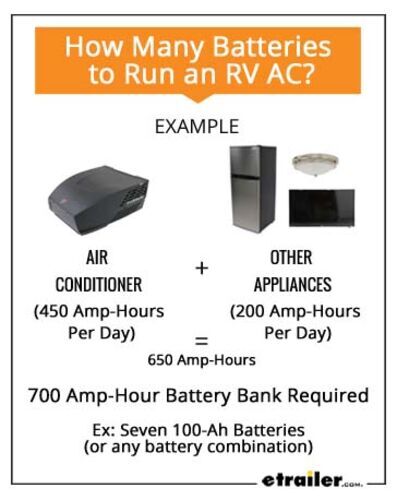
Image Source: www.etrailer.com
Deciphering RV AC Power Draw
Your RV air conditioner isn’t a simple appliance; it’s a complex system that requires a significant amount of electrical power to operate. The amount of electricity it uses is measured in amps (amperes), which is a unit of electric current. This is often referred to as the RV AC power draw or RV AC amp draw.
Understanding RV AC Watts
Before diving into amps, it’s helpful to grasp the concept of watts. Watts (W) measure the rate at which electrical energy is used. The relationship between watts, volts (V), and amps (A) is fundamental:
Watts = Volts × Amps
This formula is your key to translating amperage into a more tangible measure of power consumption. For example, if your RV AC draws 12 amps on a 120-volt system, it consumes 12 amps × 120 volts = 1440 watts when running. This helps you understand the overall energy demand.
How Many Amps Does an RV Air Conditioner Use?
The RV AC amperage is not a single, fixed number. It varies based on several factors, including the unit’s size, efficiency, the ambient temperature, and whether it’s starting up or running.
RV AC Running Amps
The most common figure you’ll encounter is the RV AC running amps. This is the amount of amperage the air conditioner draws once it has reached its stable operating state.
- Typical Range: For most standard RV air conditioners (often 13,500 BTU or 15,000 BTU units), the running amperage typically falls between 10 and 15 amps on a 120-volt AC system.
- Smaller Units: Smaller window AC units adapted for RVs might draw slightly less, perhaps around 7-10 amps.
- Larger Units: High-efficiency or larger capacity units could draw slightly more, sometimes creeping up to 16-18 amps.
It’s important to note that this is the AC unit’s consumption. Your RV also has other systems drawing power simultaneously, such as lights, refrigerators, and electronics.
RV AC Starting Amps (Inrush Current)
This is where things can get tricky. When an RV air conditioner’s compressor first kicks on, it requires a surge of power to overcome inertia and start the cooling cycle. This is known as RV AC starting amps or inrush current.
- Magnitude of Surge: The starting amps can be 2 to 3 times the running amps, and sometimes even higher. This means a unit drawing 12 running amps could briefly spike to 24 to 36 amps or more.
- Duration: This high draw is very short-lived, typically lasting only a fraction of a second to a couple of seconds. However, it’s critical for sizing circuits and generators.
Failing to account for these starting amps is a common reason for tripped breakers or overloaded generators.
RV AC Voltage: The Foundation of Power
The RV AC voltage is a critical factor in determining the amperage. Most RVs in North America operate on a 120-volt AC electrical system for their appliances.
- Standard RV Voltage: You’ll typically find 120 volts powering your RV AC unit. This is the same voltage found in most household outlets.
- Generator Output: Generators designed for RVs are usually rated to produce 120 volts.
- Shore Power: When plugged into campground utilities, you’re also receiving 120 volts.
Understanding your RV’s voltage is fundamental to calculating the total power draw.
RV AC Breaker Size: Protecting Your System
The RV AC breaker size is directly related to the expected running amps and starting amps of your air conditioner. Breakers are safety devices designed to interrupt the flow of electricity if it exceeds a safe limit, preventing damage to your wiring and appliances.
- General Rule: For a typical 13,500 BTU RV AC unit that draws around 12-15 running amps, a 15-amp or 20-amp breaker is commonly used on the 120-volt circuit.
- Why Not Match Breaker to Running Amps Exactly? You don’t want a breaker that trips every time the unit starts up. Breakers are designed to handle momentary overloads (like starting amps) without tripping immediately, but they will trip if the overload persists or is too severe.
- Manufacturer Recommendations: Always refer to the manufacturer’s specifications for your specific RV AC unit. They will recommend the appropriate breaker size.
- Wiring Gauge: The breaker size must also be matched to the wire gauge in your RV’s electrical system. Thicker wires can handle more current. Using a breaker that is too large for the wiring is a fire hazard.
Table 1: Typical RV AC Breaker Sizing (120V System)
| RV AC BTU Size | Typical Running Amps (approx.) | Recommended Breaker Size (approx.) |
|---|---|---|
| 10,000 – 13,500 | 10 – 13 | 15 Amps |
| 13,500 – 15,000 | 12 – 15 | 15 – 20 Amps |
| 15,000+ | 14 – 18 | 20 Amps |
Note: These are general guidelines. Always check your AC unit’s specifications.
What if the Breaker Trips?
If your RV AC breaker trips, it’s a sign that your electrical system is being overloaded. This could be due to:
- Too many appliances: You’re running other high-draw items at the same time as the AC.
- Starting surge: The breaker is too small to handle the initial surge of the compressor.
- Faulty unit: The AC unit itself might be malfunctioning, drawing excessive current.
- Undersized wiring: The wiring in your RV might not be adequate for the AC’s needs.
Calculating Total RV AC Power Consumption
To truly grasp your RV AC’s electrical impact, let’s combine the concepts of voltage, amperage, and wattage.
Example Calculation
Let’s say your RV air conditioner is rated for:
- Voltage: 120V AC
- Running Amps: 13 Amps
Running Watts Calculation:
Running Watts = 13 Amps × 120 Volts = 1560 Watts
Now, consider the starting amps. If the starting surge is, for instance, 2.5 times the running amps:
Starting Amps = 13 Amps × 2.5 = 32.5 Amps
The power draw during startup would momentarily be:
Starting Watts = 32.5 Amps × 120 Volts = 3900 Watts
This illustrates why starting amps are so important, especially for generators. A generator needs to be able to handle that initial burst of power.
Factors Affecting RV AC Amperage
Several variables influence how much power your RV AC consumes.
1. BTU Size of the AC Unit
Bigger units mean more cooling capacity, but also higher power consumption.
- 13,500 BTU Units: These are the most common in many RVs and typically draw the 10-15 amp range.
- 15,000 BTU Units: These will generally draw more power, pushing towards the higher end of the 10-15 amp spectrum or even slightly above.
- Smaller or Larger Units: Units outside this common range will have corresponding higher or lower power draws.
2. Ambient Temperature and Humidity
The harder your AC has to work, the more power it will use.
- Hotter Outside: On very hot days, the AC will run more often and for longer periods. The compressor will also work harder, potentially increasing the average amperage draw slightly.
- High Humidity: High humidity also makes the AC work harder to remove moisture from the air, leading to increased power consumption.
3. Efficiency of the Unit
Like home appliances, RV AC units have varying efficiency ratings. Newer, high-efficiency models might consume slightly less power for the same cooling output.
4. Age and Condition of the Unit
An older, poorly maintained AC unit might be less efficient and draw more power than when it was new. Dirty filters or coils can impede airflow, forcing the unit to work harder.
5. Fan Speed and Thermostat Setting
- Fan Speed: Running the fan on high will generally use slightly more power than running it on low.
- Thermostat: Setting the thermostat to a very low temperature will cause the unit to cycle on and off more frequently or run continuously, increasing overall consumption.
RV AC Electrical Requirements: What You Need to Know
Knowing your RV AC’s electrical needs is vital for practical reasons, from powering your unit with a generator to understanding your RV’s electrical panel.
Generator Sizing
This is perhaps the most critical application of understanding RV AC amperage.
- Starting Watts vs. Running Watts: When sizing a generator, you need to consider both the RV AC starting amps and the running amps of all other appliances you plan to run simultaneously.
- General Guideline: For a single 13,500 BTU RV AC unit, a generator with at least 2000-3000 running watts is generally recommended. This provides enough headroom for the starting surge and other basic needs.
- Dual AC Units: If your RV has two AC units, you’ll likely need a much larger generator, often in the 3500-4500 watt range or even higher, depending on the BTU size of both units and other appliances.
- Waveform: Ensure your generator provides a “pure sine wave” or “modified sine wave” output that is compatible with sensitive electronics in your RV, including the AC unit’s control board.
Table 2: Generator Wattage Considerations for RV AC Units (120V)
| RV AC BTU Size | Approx. Running Watts | Approx. Starting Watts | Minimum Recommended Generator Running Watts (for one AC + essentials) |
|---|---|---|---|
| 10,000 – 13,500 | 1200 – 1560 | 2400 – 3900 | 2000 – 3000 |
| 13,500 – 15,000 | 1440 – 1800 | 2880 – 4500 | 2500 – 3500 |
| 15,000+ | 1680 – 2160 | 3360 – 5400 | 3000 – 4000+ |
Note: These are approximate figures. Actual consumption varies. Always check your RV AC’s specifications and test with your specific setup.
Shore Power Connections
When plugged into shore power, your RV typically connects to a 30-amp or 50-amp service.
- 30-Amp Service: This provides a single 120-volt leg with a maximum capacity of 30 amps. A single RV AC unit (drawing 10-15 amps) can usually run on a 30-amp service, but you’ll need to be mindful of other high-draw appliances. Running the AC, microwave, and toaster simultaneously on a 30-amp service is a recipe for a tripped breaker.
- 50-Amp Service: This is more robust, typically providing two separate 120-volt legs, each with a 50-amp capacity. This is equivalent to 120/240V service, but RVs usually utilize both 120V legs for their 120V appliances. A 50-amp service can easily power two RV AC units and all other appliances in your rig.
RV Electrical Panel and Wiring
Your RV’s electrical panel contains circuit breakers for different circuits.
- Dedicated Breaker: The AC unit will have its own dedicated circuit breaker. The size of this breaker (as discussed earlier, usually 15 or 20 amps) is crucial.
- Wire Gauge: The wiring leading to the AC unit must be appropriately sized for the breaker and the expected load. Using undersized wiring with an oversized breaker is dangerous.
Tips for Managing Your RV AC Power Consumption
Here are some practical tips to help you manage your RV AC’s electrical needs:
1. Pre-Cool Your RV
If you’re using a generator or shore power, turn on the AC before you need it to cool the rig down. This allows it to reach a stable operating temperature before you start using other appliances.
2. Manage Other Appliances
- Stagger Use: Avoid running multiple high-draw appliances (microwave, hair dryer, coffee maker) at the same time as the AC.
- Energy-Efficient Options: Consider using propane for cooking or refrigeration if your RV has that option, as these systems don’t draw AC power.
3. Maintain Your RV AC Unit
- Clean Filters: Regularly clean or replace the air filter. A clogged filter restricts airflow, making the unit work harder and consume more power.
- Clean Coils: Keep the condenser coils (usually on the roof) clean and free of debris.
- Professional Servicing: Have your AC unit serviced periodically to ensure it’s running efficiently.
4. Use a Soft Starter (Advanced)
For those who frequently run their AC on smaller generators, a “soft starter” can be installed on the AC unit. This device helps to reduce the initial inrush current, making it easier for smaller generators to start and run the AC.
5. Optimize Thermostat Settings
- Avoid Extreme Settings: Don’t set the thermostat to its lowest possible setting. A more moderate temperature (e.g., 72-75°F) will require less energy to maintain.
- Programmable Thermostats: If your RV AC has a programmable thermostat, use it to cool the RV down before you arrive and then raise the temperature when you’re away.
6. Use Fans
Ceiling fans or portable fans can help circulate air and make the RV feel cooler, allowing you to set the thermostat a few degrees higher.
7. Insulate Your RV
Proper insulation helps keep the cool air in and the hot air out, reducing the workload on your AC. Check for air leaks around windows and doors.
Frequently Asked Questions (FAQ)
Q1: Can I run my RV AC on a 2000-watt generator?
A: It depends on the BTU size of your AC unit. A smaller 10,000-13,500 BTU unit with an efficient motor might start and run on a 2000-watt generator, especially if it’s a high-quality unit with good surge capacity. However, for most 13,500 BTU units and larger, or if you plan to run anything else, a 2000-watt generator will likely be insufficient due to the starting amps. A 3000-watt generator is a more common recommendation for a single RV AC unit.
Q2: How many amps does a 15,000 BTU RV AC use?
A: A 15,000 BTU RV air conditioner typically uses around 14 to 18 amps when running on a 120-volt system. Its starting amps can spike significantly higher.
Q3: Can I plug my RV AC into a standard household outlet (15 amp)?
A: If your RV AC unit draws 10-15 running amps, it might run on a dedicated household outlet circuit that has a 15-amp breaker. However, you must ensure that no other appliance is running on that same circuit. Furthermore, you must account for the starting amps, which could still trip the breaker even if the running amps are within limits. It’s generally not recommended for continuous use without careful monitoring.
Q4: What is the difference between RV AC amperage and household AC amperage?
A: The fundamental principles are the same, but RV AC units are typically smaller and designed for lower power consumption due to the limitations of RV generators and shore power hookups (30-amp service is common). Household AC units are often much larger and designed for the higher capacity of standard home electrical systems (typically 30-amp or 50-amp circuits for central AC).
Q5: Why does my RV AC breaker keep tripping?
A: This is usually due to the electrical load exceeding the breaker’s rating. Common causes include running too many appliances simultaneously, the AC unit drawing more power than expected (possibly due to maintenance issues or age), or the breaker being too small for the AC unit’s starting surge.
Q6: How do I find out the exact amperage of my RV AC unit?
A: The most reliable way is to check the nameplate or sticker on the air conditioner unit itself. This will list the voltage, amperage (often listed as “FLA” for Full Load Amps), and wattage. Your RV’s owner’s manual or the AC unit’s manual should also contain this information.
By delving into RV AC amperage, RV air conditioner power consumption, and the associated RV AC electrical requirements, you’re better equipped to manage your RV’s electrical system effectively. From selecting the right generator to avoiding nuisance tripped breakers, knowing these details ensures a more comfortable and hassle-free RV experience.

My name is Carlos Gadd, and I am the creator of AirPurityGuide.com.. With a passion for footwear, I share my experiences, insights, and expertise about shoes. Through my blog, I aim to guide readers in making informed decisions, finding the perfect pair, and enhancing their footwear knowledge. Join me on this journey to explore everything about shoes!