
When you’re enjoying a road trip in your recreational vehicle (RV), nothing ruins the experience quite like a malfunctioning air conditioner. A common question for RV owners is: How many amps does an RV air conditioner draw? The answer varies depending on the size and type of AC unit, but typically, a standard RV air conditioner can draw anywhere from 8 to 15 amps while running and significantly more for a brief moment when it starts up.
Understanding the electrical needs of your RV air conditioner is crucial for several reasons. It helps you determine if your RV’s electrical system, including your generator or shore power connection, can handle the load. It also informs the correct sizing of your RV AC circuit breaker and helps prevent electrical overloads that can damage your appliances and wiring. This guide will delve deep into the RV AC amperage, RV air conditioner power consumption, RV AC wattage, and all the related electrical requirements to ensure your comfort and safety on the road.
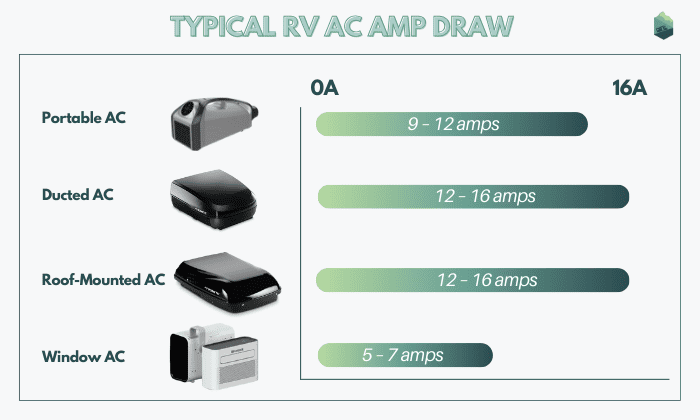
Image Source: www.outdoorbits.com
Deciphering RV AC Amperage and Power Consumption
The amount of electricity an RV air conditioner uses, often measured in amps or watts, is a key factor in managing your RV’s power. This RV AC amperage isn’t static; it fluctuates based on several factors.
RV AC Wattage: The Heart of the Matter
Before diving into amps, it’s helpful to understand watts. Wattage is the measure of electrical power. The relationship between watts, volts, and amps is fundamental:
Watts (W) = Volts (V) × Amps (A)
RV air conditioners typically operate on 120 volts. So, if you know the wattage of your AC unit, you can easily calculate its amp draw. For example, a 1500-watt RV air conditioner running on 120 volts would draw:
Amps (A) = Watts (W) / Volts (V) = 1500 W / 120 V = 12.5 Amps
This is the RV AC running amps, which is the steady amount of current the unit draws once it’s up and cooling.
RV AC Starting Amps: The Surge of Power
A critical factor often overlooked is the RV AC starting amps. When an air conditioner compressor kicks on, it requires a much higher surge of electricity for a very brief period – often milliseconds to a few seconds. This surge is commonly referred to as “surge amps” or “locked rotor amps” (LRA). This initial power demand can be two to three times the normal running amps.
For instance, an RV air conditioner that normally draws 12.5 running amps might have a starting amp draw of 30-40 amps or even more. This is why it’s essential to have a power source and wiring capable of handling these brief, high-demand spikes. If your RV AC circuit breaker is too small, it will trip immediately when the AC attempts to start.
RV Air Conditioner Power Consumption: What Influences It?
Several factors contribute to the overall RV air conditioner power consumption, impacting the RV AC amperage draw.
Unit Size and Cooling Capacity
The most significant factor influencing RV AC amperage is the size and cooling capacity of the unit, often measured in BTUs (British Thermal Units). Larger units designed to cool bigger RVs or provide more intense cooling will naturally consume more power.
- Smaller Units (5,000-8,000 BTU): These are typically found in smaller RVs or camper vans and might draw around 5-8 running amps. Their starting amps could be in the range of 15-25 amps.
- Medium Units (10,000-13,500 BTU): These are common in many travel trailers and fifth wheels. They generally draw 8-12 running amps, with starting amps potentially reaching 25-35 amps.
- Larger Units (15,000+ BTU): Found in larger motorhomes or RVs requiring significant cooling, these units can draw 10-15 running amps or more, and their starting amps can be 35-50 amps or higher.
Ambient Temperature and Thermostat Setting
The ambient temperature outside your RV and the temperature you set on your thermostat play a role. On a very hot day, the AC will have to work harder to maintain the desired temperature, leading to longer run cycles and slightly higher power consumption. Conversely, on a milder day, it will cycle on and off more frequently, and the average RV AC power consumption might be lower.
Efficiency of the Unit
Like any appliance, RV air conditioners have varying levels of efficiency. Newer, more energy-efficient models will generally draw fewer amps for the same cooling output compared to older, less efficient units. Look for ENERGY STAR ratings or EER (Energy Efficiency Ratio) figures when purchasing a new unit.
Condition and Maintenance
A well-maintained RV air conditioner will run more efficiently than one that is dirty or in disrepair. Clogged filters, dirty coils, or refrigerant leaks can all force the unit to work harder, increasing its RV AC power consumption.
RV AC Electrical Requirements: Ensuring Proper Setup
Meeting the specific RV AC electrical requirements is paramount for safe and reliable operation. This involves understanding your RV’s electrical system and the demands of the AC unit.
RV AC Circuit Breaker Size
The circuit breaker protecting your RV air conditioner is designed to interrupt the flow of electricity if the current exceeds a safe limit, preventing overheating and fires. The size of the circuit breaker must be matched to the AC unit’s expected load, taking into account both running amps and starting amps.
- General Rule of Thumb: A common recommendation is to size the circuit breaker at least 25% higher than the AC unit’s running amp draw. This accounts for slight variations and ensures the breaker doesn’t trip unnecessarily during normal operation.
- Example: For an AC unit drawing 12.5 running amps, a 15-amp breaker might be sufficient, but a 20-amp breaker would provide a better margin of safety, especially considering the starting surge.
- Consult the Manufacturer: Always refer to the AC unit’s owner’s manual or the manufacturer’s specifications for the recommended RV AC circuit breaker size. They will provide the precise rating required for optimal performance and safety.
Shore Power and Generator Capacity
Your RV’s power source must be able to supply the necessary amperage for the air conditioner to run without overloading.
- Shore Power: When connected to external power (like at a campground), you’ll typically use either a 30-amp or 50-amp service.
- A 30-amp service provides a single 120-volt line capable of delivering up to 30 amps. This is generally sufficient for running one medium-sized RV air conditioner, especially if other high-draw appliances are not used simultaneously. However, a 15,000 BTU AC unit might push the limits of a 30-amp service, especially when combined with other electrical loads.
- A 50-amp service provides two 120-volt lines, each capable of delivering up to 50 amps, effectively giving you 100 amps of total capacity (though it’s often described as delivering 100 amps at 120V, it’s more accurately two distinct 50A legs). This is ample power for running one or even two RV air conditioners, along with other appliances.
Generators: The size of your generator is critical. You need a generator that can handle the continuous running amps of the AC unit and the momentary surge of the RV AC starting amps.
- Starting Requirements: To accurately size a generator, you need to know the surge watts (or starting watts) and the running watts (or continuous watts) of your AC unit. The generator’s output must exceed both.
- Example: If your 13,500 BTU AC unit draws 12 running amps (1500 watts) and has a 35-amp start surge (4200 watts), you’ll need a generator that can reliably provide at least 1500 running watts and 4200 starting watts. Many generators are rated in total watts, so check the specifications carefully. A generator with a sustained output of 3000-3500 watts is often recommended for running a single, larger RV air conditioner comfortably.
Wiring Considerations
The gauge of the wiring used in your RV’s electrical system is designed to safely handle specific amp loads. Using the wrong size breaker or connecting to an inadequate power source can cause the wiring to overheat, leading to potential fire hazards. Ensure your RV’s wiring is in good condition and appropriate for the loads it’s expected to carry.
Navigating RV AC Amp Draw Charts and Calculators
To simplify the process of determining your RV AC’s electrical demands, several resources are available.
RV AC Amp Draw Chart
An RV AC amp draw chart can be a useful reference tool. These charts typically list various BTU sizes of RV air conditioners and their estimated running and starting amperage draws. While these charts provide good general estimates, they are not a substitute for the manufacturer’s specific data for your particular unit.
Here’s a sample RV AC amp draw chart (values are approximate and can vary by manufacturer and model):
| BTU Size | Estimated Running Amps (120V) | Estimated Starting Amps (120V) | Estimated Wattage (Running) | Recommended Breaker Size |
|---|---|---|---|---|
| 5,000 | 5 – 7 | 15 – 25 | 600 – 840 | 10 – 15 Amps |
| 8,000 | 7 – 9 | 20 – 30 | 840 – 1080 | 15 Amps |
| 10,000 | 8 – 10 | 25 – 35 | 960 – 1200 | 15 Amps |
| 13,500 | 9 – 13 | 30 – 40 | 1080 – 1560 | 15 – 20 Amps |
| 15,000 | 10 – 14 | 35 – 45 | 1200 – 1680 | 20 Amps |
| 18,000+ | 12 – 16+ | 40 – 50+ | 1440 – 1920+ | 20 – 25 Amps |
Important Note: Always verify the exact specifications with your AC unit’s manual.
RV AC Amp Draw Calculator
An RV AC amp draw calculator can help you estimate power needs. These online tools often allow you to input the wattage of your AC unit or its BTU size, and they will calculate the approximate amperage draw. Some advanced calculators might also factor in other appliances you plan to run simultaneously to give you a total electrical load estimate. These are useful for rough planning, especially when considering generator purchases or managing power on shore power.
Optimizing Power Usage for Your RV Air Conditioner
To make the most of your RV’s electrical system and ensure your AC runs smoothly, consider these tips for optimizing power usage:
Start AC First
When connecting to shore power or starting your generator, try to start your air conditioner first, before turning on other high-draw appliances like microwaves, coffee makers, or hair dryers. This allows the AC unit to receive the necessary surge of power without competing with other loads.
Soft Starters
For larger AC units or RVs with limited power, consider installing a “soft starter” or “hard start capacitor.” These devices are designed to reduce the initial surge current required by the compressor motor. This can help prevent tripping breakers, reduce stress on your generator, and potentially allow you to run your AC on a lower-amperage power source than you otherwise could.
Manage Other Appliances
Be mindful of what other appliances you are running concurrently with your RV air conditioner. Avoid running the microwave, a high-wattage coffee maker, or electric heaters at the same time as the AC, especially if you are on a 30-amp service.
Regular Maintenance
Keep your AC unit clean and well-maintained. Regularly clean or replace the air filter. Check for any ice buildup on the coils, which indicates airflow issues or low refrigerant. Proper maintenance ensures peak efficiency and lower power consumption.
Consider a Portable Solar Setup
While a full solar system might not be enough to power a running AC unit constantly, it can help offset some of the power consumption and reduce the load on your generator or battery bank, especially for the fan mode.
RV AC Power Source: What Are Your Options?
Your RV AC needs a reliable RV AC power source. The primary options are:
Shore Power: This is the electricity provided from an external source, usually a campground pedestal. It’s typically 30-amp or 50-amp 120-volt service. This is the most common and often the most convenient way to power your RV AC.
Generator: An onboard or portable generator provides electricity when you are not connected to shore power. The generator’s wattage capacity and ability to handle surge loads are critical for running an RV AC.
Inverter/Battery Bank: While technically possible to power an RV AC directly from a battery bank via an inverter, this is generally not practical for extended AC usage due to the extremely high power demands of air conditioning units. Inverter/battery systems are more suited for running smaller loads or for short durations, or to supplement other power sources. Running a full AC unit would require a massive and expensive battery bank and inverter system.
Frequently Asked Questions (FAQ)
Q1: Can I run my RV air conditioner on a standard 15-amp household outlet?
A1: It depends on the size of your RV air conditioner and whether it’s the only appliance drawing power from that circuit. A small 5,000 BTU unit might run, but a larger 13,500 BTU or 15,000 BTU unit will likely overload a standard 15-amp circuit, especially during startup. It’s generally not recommended for continuous use without risking tripping the breaker or damaging the circuit.
Q2: How do I know if my generator is big enough to run my RV AC?
A2: You need to know the running watts and starting (surge) watts of your RV air conditioner. Check the AC unit’s specifications plate or manual. Then, ensure your generator’s continuous wattage output is greater than the AC’s running watts, and its starting (surge) wattage output is greater than the AC’s starting (surge) watts. It’s wise to have some buffer capacity in your generator.
Q3: Will running my RV AC affect other appliances?
A3: Yes, especially on a 30-amp service. If your AC is drawing a significant portion of the available amps, running other high-draw appliances (like a microwave, hairdryer, or toaster) simultaneously can cause the circuit breaker to trip or lead to voltage drops that could harm sensitive electronics.
Q4: What happens if my RV AC draws too many amps?
A4: If the RV AC draws too many amps, it will cause the circuit breaker or fuse protecting that circuit to trip or blow. This is a safety mechanism designed to prevent overheating of wires and potential fires. If the breaker trips repeatedly, it indicates a problem with the AC unit, the wiring, or the power source.
Q5: Is there a way to reduce the amp draw of my RV AC?
A5: Yes, you can reduce the perceived amp draw by using a soft starter. Additionally, regular maintenance, cleaning filters, and ensuring proper airflow can improve efficiency, indirectly leading to a more optimized amp draw. Consciously limiting the use of other high-draw appliances at the same time also helps manage the overall electrical load.
By arming yourself with the knowledge of your RV air conditioner’s electrical demands, you can ensure comfortable travels, prevent electrical issues, and make informed decisions about your RV’s power system. Always prioritize safety and consult your RV and appliance manuals for specific recommendations.

My name is Carlos Gadd, and I am the creator of AirPurityGuide.com.. With a passion for footwear, I share my experiences, insights, and expertise about shoes. Through my blog, I aim to guide readers in making informed decisions, finding the perfect pair, and enhancing their footwear knowledge. Join me on this journey to explore everything about shoes!